
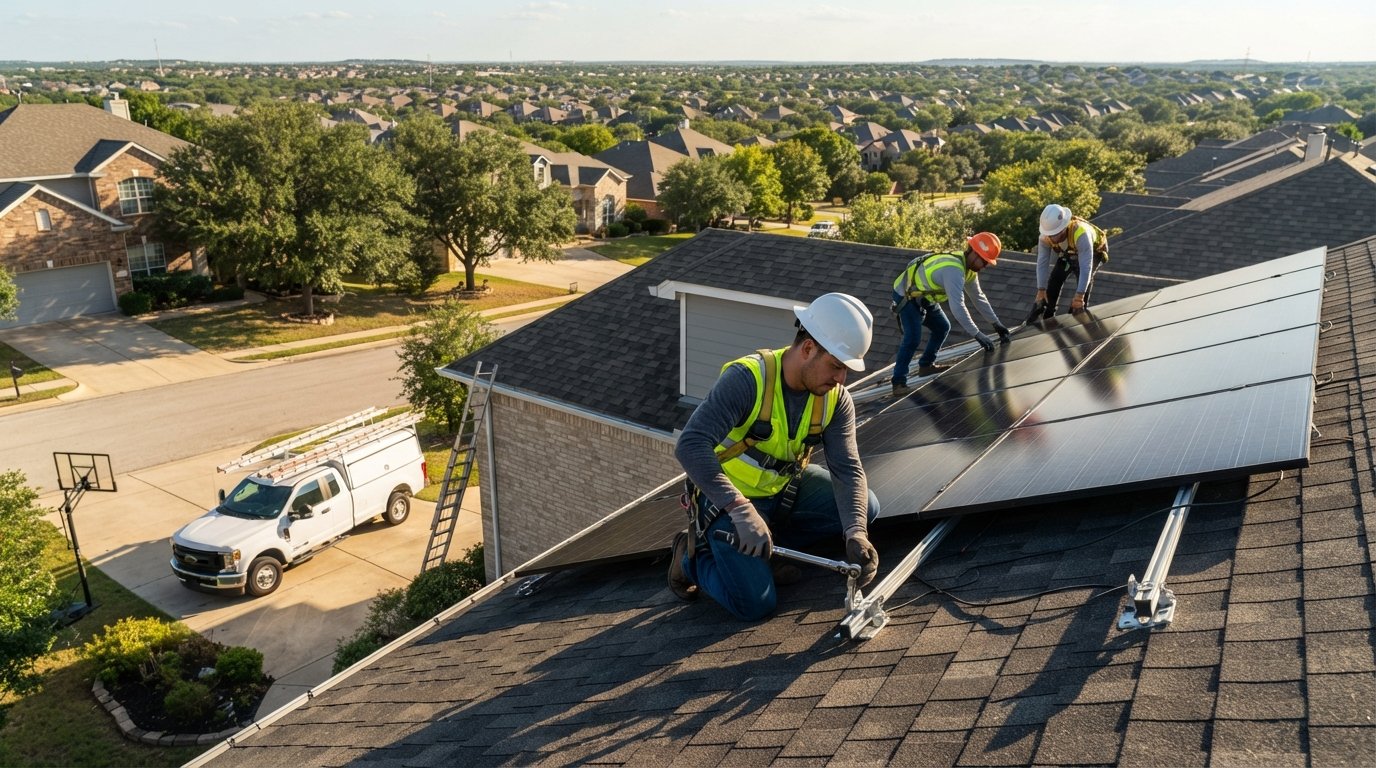
Best Solar Installers in Texas 2026: Reviews and Tips
Compare the best solar installers in Texas 2026 reviews. Learn how to vet companies, avoid red flags, and maximize savings on your solar investment.

By Alex Carter
Learn more about Solar Panel Installation and Repair for guides, costs, and what to expect.
Compare Solar Panel Installation and Repair Pros Near You

Enter your ZIP code to compare top-rated local professionals and request free quotes.
Choosing a solar installer in Texas can feel overwhelming with hundreds of companies claiming to be the best. The state leads the nation in solar capacity, yet not all installers deliver the same quality, warranty support, or financial transparency. This guide breaks down what actually matters when comparing the best solar installers in Texas 2026 reviews, so you can avoid costly mistakes and maximize your return on investment.
Texas homeowners face unique energy challenges: deregulated electricity markets, extreme summer heat, and grid reliability concerns. A well-installed solar system can slash your electric bills by 50 to 70 percent, but only if the installer gets the design, permitting, and interconnection right. Poor workmanship leads to roof leaks, underperforming panels, and warranty nightmares that can cost thousands to fix.
Why Texas Is a Top Market for Solar in 2026
Texas installed more solar capacity than any other state in 2025, according to the Solar Energy Industries Association. The combination of high electricity rates, abundant sunshine, and favorable net metering policies in many utility territories makes solar an attractive investment. Federal incentives, including the 30 percent Investment Tax Credit, remain available through 2032, though the exact rules for claiming it depend on your tax situation and system ownership.
Utility-scale solar farms dominate the headlines, but residential installations grew 22 percent year over year. Major utilities like Oncor, CenterPoint, and AEP Texas have streamlined interconnection processes, reducing approval times from months to weeks in many areas. That means your system can start generating power faster, improving your payback period.
Another factor driving adoption is the Texas grid's vulnerability to extreme weather. After Winter Storm Uri and several record-breaking heat waves, homeowners increasingly view solar plus battery storage as a resilience investment, not just a cost-saving measure. Installers who specialize in backup power solutions are in high demand, and their reviews often highlight how well the system performed during outages.
How to Evaluate Solar Installers: A Practical Framework
Not every company that sells solar deserves your business. The best solar installers in Texas 2026 reviews consistently share several traits: transparent pricing, in-house installation crews, strong warranties, and a track record of satisfied customers. Before you sign anything, run every candidate through a structured evaluation.
Start with licensing and certifications. Texas does not require a statewide solar license, but reputable installers hold electrical contractor licenses from the Texas Department of Licensing and Regulation. They also employ North American Board of Certified Energy Practitioners (NABCEP) certified professionals, which signals a commitment to industry best practices. Membership in the Texas Solar Energy Society is another positive indicator.
Next, scrutinize the warranty package. Panel manufacturers typically offer 25-year performance warranties, but the installation workmanship warranty is separate and varies widely. Look for at least 10 years on labor, and confirm the company has a physical presence in Texas. Out-of-state installers that subcontract work often disappear when problems arise. You can read more about how solar installers are matched to save on energy bills to understand the vetting process that reputable platforms use.
Finally, request references from customers whose systems were installed at least two years ago. Recent installations look great on day one, but long-term performance reveals whether the installer sized the system correctly, addressed shading issues, and provided responsive service after the sale.
Top Solar Installers in Texas for 2026: Reviews and Rankings
The following companies earned strong reviews from Texas homeowners and industry watchdogs in 2025 and early 2026. Rankings consider customer satisfaction, installation quality, warranty terms, financing options, and local expertise. Prices and availability vary by region, so request multiple quotes before deciding.
1. Freedom Solar Power (Austin, Houston, Dallas, San Antonio)
Freedom Solar Power remains the largest residential solar installer headquartered in Texas. The company handles everything in-house, from design and engineering to installation and service, which gives it tight quality control. Its partnership with SunPower (now Complete Solaria) provides access to high-efficiency panels, though the bankruptcy of SunPower in 2024 raised questions about warranty support. Freedom Solar has since diversified its equipment offerings and continues to receive positive reviews for customer communication.
Typical system costs range from $2.80 to $3.40 per watt before incentives, which is competitive for premium equipment. Financing options include $0-down loans and leases, though the lease terms are less favorable than buying outright. Homeowners consistently praise the company's project managers for keeping them informed throughout permitting and installation.
2. Longhorn Solar (Austin, San Antonio)
Longhorn Solar built its reputation on local expertise and personalized service. The company installs fewer systems per month than the big regional players, which allows it to customize each design. Reviews highlight the sales team's willingness to explain technical details without pressure, a refreshing change from high-pressure national brands.
Longhorn uses Tier 1 panels from manufacturers like REC and Q CELLS, paired with Enphase microinverters or SolarEdge string inverters. Battery storage options include Tesla Powerwall and Enphase IQ Batteries. The company offers a 10-year workmanship warranty and a 25-year panel performance warranty. Pricing sits in the middle of the market, around $2.60 to $3.10 per watt.
3. Texas Solar Integrated (Dallas-Fort Worth)
Texas Solar Integrated focuses on the DFW metroplex and surrounding counties. The company differentiates itself through roof-integrated solar options, which appeal to homeowners who want a cleaner aesthetic. Its installers are trained on standing seam metal roofs and composite shingle systems, reducing the risk of leaks.
Customer reviews frequently mention the thorough site audit and shading analysis. Texas Solar Integrated uses drone imaging and software modeling to predict production accurately, then compares those projections to actual output after installation. Financing includes credit union partnerships with rates as low as 4.99 percent APR for qualified buyers.
4. Solar CenTex (Waco, Killeen, Temple)
Solar CenTex serves Central Texas and has earned a loyal following for its educational approach. The company hosts monthly workshops where homeowners can learn about solar technology, incentives, and financing without a sales pitch. That transparency translates into high customer satisfaction scores.
The company specializes in grid-tied systems with optional battery backup. It uses Enphase microinverters exclusively, which simplifies troubleshooting and allows panel-level monitoring. Solar CenTex's workmanship warranty is 12 years, one of the longest in the state. Pricing is competitive, with systems starting around $2.50 per watt for standard configurations.
5. Good Faith Energy (Statewide)
Good Faith Energy operates across Texas with a focus on ethical sales practices. The company publishes its pricing online, a rarity in the solar industry, and does not employ commissioned salespeople. Instead, energy consultants earn salaries, removing the incentive to oversell.
Good Faith installs REC Alpha and Silfab panels with Enphase or SolarEdge inverters. Battery options include FranklinWH and Tesla Powerwall. The company offers a 25-year workmanship warranty, which is among the best available. Reviews praise the post-installation support, including monitoring setup and troubleshooting.
Red Flags to Avoid When Hiring a Solar Installer
The solar industry attracts both dedicated professionals and opportunistic fly-by-night operators. Protect yourself by watching for these warning signs.
- High-pressure sales tactics: Legitimate installers give you time to review quotes and ask questions. If a salesperson pressures you to sign on the spot or claims a limited-time discount, walk away.
- No physical address: Verify the company has a real office in Texas. P.O. boxes and virtual addresses are common among scammers.
- Subcontracted installation: Ask who will actually install the system. If the answer is a third-party crew you cannot vet, quality control suffers.
- Vague warranties: Get warranty terms in writing before signing. Verbal promises are worthless if the company goes out of business.
- Unrealistic production estimates: If a quote promises 100 percent offset of your electric bill without accounting for shading, roof orientation, or seasonal variation, the numbers are inflated.
Another red flag is a quote that significantly undercuts competitors without explanation. Solar equipment costs are fairly consistent across installers, so a price that is 30 percent lower than everyone else usually means lower-quality panels, inexperienced labor, or hidden fees that appear later.
Understanding Solar Costs and Financing in Texas
Solar pricing in Texas ranges from $2.30 to $3.50 per watt before incentives, depending on equipment, system size, and installer overhead. A typical 8-kilowatt system for a median-sized home costs between $18,400 and $28,000 before the 30 percent federal tax credit. After the credit, that drops to $12,880 to $19,600.
Financing options fall into four categories: cash purchase, solar loans, leases, and power purchase agreements (PPAs). Cash purchase offers the best long-term return but requires upfront capital. Solar loans let you own the system with $0 down, though interest rates range from 4 to 9 percent depending on credit score. Leases and PPAs require no upfront cost but you do not own the system, and the savings are smaller.
Texas does not offer a statewide solar tax credit, but some utilities provide rebates. Austin Energy, CPS Energy, and Oncor offer performance-based incentives that can add up to $2,500 for qualifying systems. Net metering policies vary by utility: some credit you at the retail rate for excess power, while others pay a lower wholesale rate. Understanding your utility's policy is critical for accurate savings projections.
To compare quotes effectively, use the same system size and equipment assumptions across all installers. Ask each company to provide a production estimate using PVWatts or a similar tool, and request a breakdown of equipment, labor, permitting, and overhead costs. That transparency makes it easier to spot outliers.
What Texas Homeowners Say: Real Reviews and Experiences
Online reviews provide valuable insights, but they must be read critically. A company with hundreds of five-star reviews may be excellent, or it may be gaming the system with incentivized feedback. Look for detailed reviews that mention specific employees, installation timelines, and problem resolution.
Common themes in positive reviews include clear communication, on-time installation, and responsive service after the sale. Negative reviews often cite delays in permitting, damage to roofs or landscaping, and difficulty reaching customer support. Pay attention to how companies respond to negative reviews: a thoughtful response that offers to resolve the issue signals good faith.
For a broader perspective on how installers are vetted and matched with homeowners, and to explore additional resources on solar financing and incentives, you can visit FreeSolarPowerQuotes, which provides educational tools and connects consumers with reputable providers.
Steps to Get the Best Solar Deal in Texas
Follow this sequence to maximize your savings and minimize risk.
- Assess your energy usage: Review 12 months of electric bills to calculate your average monthly consumption. This determines the system size you need.
- Evaluate your roof: Check the age, condition, and orientation of your roof. South-facing roofs with minimal shading are ideal. If your roof needs replacement soon, do that first.
- Request at least three quotes: Compare pricing, equipment, warranties, and financing terms. Do not automatically choose the cheapest option.
- Verify credentials: Confirm licensing, insurance, and NABCEP certifications. Check the Better Business Bureau and Texas Attorney General's consumer complaints database.
- Review the contract carefully: Ensure it includes system specifications, production guarantees, warranty terms, and a timeline. Avoid contracts with arbitration clauses that limit your legal rights.
- Schedule installation and inspection: After permitting is approved, installation typically takes one to three days. A city or county inspector will verify the work before your utility grants permission to operate.
The entire process, from signing to flipping the switch, usually takes four to eight weeks in Texas. Delays often stem from utility interconnection queues, so ask your installer about current timelines in your area.
Final Thoughts on Choosing the Best Solar Installer in Texas
The best solar installers in Texas 2026 reviews share a commitment to transparency, quality, and customer service. Whether you choose a large regional player like Freedom Solar or a boutique firm like Longhorn Solar, prioritize companies that provide detailed quotes, stand behind their work, and have a physical presence in the state. Solar is a 25-year investment, so taking the time to vet installers thoroughly pays off in reliable performance and peace of mind.