
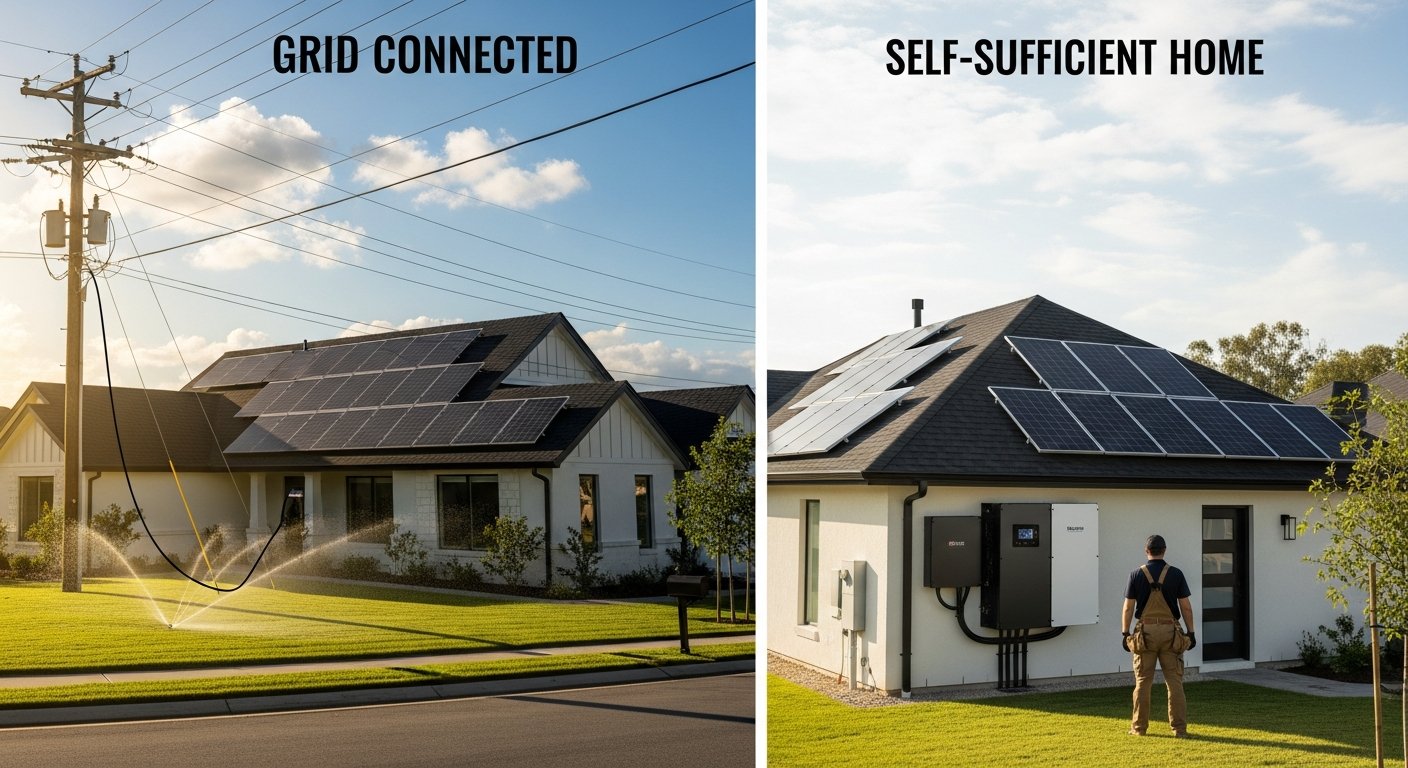
Grid Tied vs Off Grid: Which Solar System Is Right for You?
Choosing between grid tied vs off grid solar affects your energy costs and independence. This guide breaks down the pros and cons.

By Andy Pearson
Learn more about Solar Panel Installation and Repair for guides, costs, and what to expect.
Compare Solar Panel Installation and Repair Pros Near You

Enter your ZIP code to compare top-rated local professionals and request free quotes.
Choosing between a grid tied and an off grid solar system is one of the most important decisions you will make on your renewable energy journey. The wrong choice can leave you either overpaying for infrastructure you do not need or without power when the grid goes down. Understanding how each configuration works with your home, your budget, and your local utility rules is the key to getting the most out of your investment. This article breaks down the core differences, the real-world trade-offs, and the steps you can take to decide which path works best for your situation.
What Is a Grid Tied Solar System?
A grid tied solar system (also called a grid connected or on grid system) is directly connected to the local utility grid. The solar panels generate electricity during the day, and any excess power is sent back to the grid. At night or during cloudy weather, you draw power from the grid as usual. This arrangement requires no battery storage for basic operation, which dramatically lowers the upfront cost.
The financial engine of a grid tied system is net metering or a similar export tariff. When your panels produce more electricity than your home uses, the utility credits your account. You can then use those credits to offset the power you take from the grid later. Depending on your state and utility, these credits may roll over month to month or be paid out at a lower rate at the end of the year. Net metering policies vary widely, so it is critical to check what is available in your area before committing to a grid tied design.
Pros and Cons of Grid Tied Systems
Grid tied systems are the most popular choice in the United States because they offer the fastest return on investment.
- Lower upfront cost: No battery purchase required. The solar panels and inverter only need to cover your daytime load.
- Net metering savings: You can earn credits for excess generation, effectively using the grid as a free battery.
- Simpler maintenance: Fewer components mean fewer failure points and lower service costs.
- Dependence on the grid: When the utility fails (grid outage), a standard grid tied inverter shuts down for safety reasons. You lose power even if the sun is shining.
- Rate changes: Utility policies can shift over time, reducing the value of your exported power.
For homeowners in areas with reliable grid service and favorable net metering, grid tied solar is often the most cost effective way to lower electricity bills. However, if blackouts are common or if your utility pays very little for exported power, the lack of backup becomes a significant drawback.
What Is an Off Grid Solar System?
An off grid solar system operates independently from the utility grid. It must generate, store, and manage all of the electricity your home uses. The core components include solar panels, a charge controller, a battery bank, and an inverter capable of creating a standalone AC signal. Because there is no utility connection to fall back on, the system must be sized carefully to handle both your daily loads and several days of low sunlight.
Off grid living requires a shift in energy habits. You become the utility operator. This means monitoring battery state of charge, managing loads to avoid draining the battery, and planning for seasonal variations in solar production. Many off grid homeowners combine solar with a backup generator (typically powered by propane or diesel) to cover extended periods of bad weather. The upfront cost is significantly higher than a comparable grid tied system due to the battery bank and charge controller.
Pros and Cons of Off Grid Systems
Off grid systems appeal to homeowners who want energy independence or live in remote areas where grid connection is expensive or impossible.
- Energy independence: You are not affected by utility rate increases, blackouts, or grid instability.
- No electric bill: Once the system is paid off, your electricity costs drop to near zero (excluding maintenance and eventual battery replacement).
- Ideal for remote locations: If bringing utility power to your property would cost tens of thousands of dollars, off grid solar is often cheaper.
- Higher upfront cost: Batteries, charge controllers, and larger inverters add significant expense. A typical off grid system can cost 50-100 percent more than an equivalent grid tied setup.
- Ongoing maintenance: Batteries degrade over time. Lead-acid batteries require watering and equalization. Lithium batteries are more expensive but need less attention.
- Energy limitations: You must manage your power use carefully. Running large appliances during cloudy periods may require a generator.
Off grid systems are not for everyone. They require a higher initial budget and a willingness to actively manage energy consumption. But for those who value self-sufficiency or live far from power lines, the freedom from monthly utility bills can be life changing.
Grid Tied vs Off Grid: Key Differences at a Glance
To make an informed decision, it helps to compare the two configurations across the factors that matter most to homeowners.
- Cost: Grid tied is generally 50-70 percent cheaper than off grid for the same energy production because batteries and charge controllers are expensive. Off grid systems also need to be oversized to handle cloudy days, increasing panel and inverter costs.
- Reliability of power: Grid tied systems shut down during a blackout (unless you add a battery with islanding capability). Off grid systems provide continuous power as long as the battery is charged.
- Return on investment: Grid tied systems pay back faster through net metering and lower upfront cost. Off grid systems have longer payback periods but can eliminate the electric bill entirely.
- Maintenance: Grid tied systems have low maintenance (panel cleaning and inverter checks). Off grid systems require battery monitoring, replacement every 5-15 years, and occasional generator servicing.
- Scalability: Grid tied systems can be expanded later by adding more panels. Off grid systems must be designed with the final load in mind because the battery and inverter need to match the total capacity.
Each factor interacts with your personal situation. For example, if you live in an area with frequent storms and unreliable grid power, the higher cost of off grid may be justified by the peace of mind of never losing power. Conversely, in a city with stable grid service and full retail net metering, grid tied solar will likely produce the best financial return.
Choosing the Right System for Your Home
There is no single best answer for grid tied vs off grid. The right choice depends on three main variables: your utility environment, your energy needs, and your budget.
Your Location and Utility Rules
Start by researching your local net metering policy. States like California, New York, and Massachusetts have strong net metering rules that make grid tied solar very attractive. Other states have limited or no net metering, which weakens the case for grid tied. If your utility charges high fixed fees or offers low export rates, the financial benefit of grid tied drops. In those cases, a grid tied system with battery storage (a hybrid) may be a better fit, or you may want to consider going fully off grid if the utility connection cost is high.
Also consider grid reliability. If your area experiences frequent or long power outages, a standard grid tied system without backup will leave you in the dark. Off grid systems or grid tied with battery backup solve that problem. Use tools like the reliability statistics from your utility or local outage maps to gauge how often you face blackouts.
Your Energy Consumption and Backup Needs
Calculate your average daily electricity usage in kilowatt-hours (kWh). An off grid system must be sized to meet that load plus a buffer for cloudy days. A typical rule of thumb is 2-3 days of autonomy without sun. That requires a large battery bank. If your daily consumption is high (over 30 kWh per day), off grid solar becomes very expensive because you need many batteries. Grid tied systems can handle any consumption level because they use the grid as the backup.
Think about your critical loads. If you only need to keep the lights, refrigerator, and a few outlets running during an outage, a small battery backup on a grid tied system may suffice. If you want to run air conditioning, well pumps, or electric heating during blackouts, an off grid system or a large hybrid system is necessary.
Your Budget and Available Incentives
The federal Investment Tax Credit (ITC) currently offers a 30 percent tax credit for solar systems, and that applies to both grid tied and off grid installations. However, off grid systems have higher total cost, so the credit dollar amount is larger but the net out-of-pocket remains higher. Some states also offer additional rebates for battery storage, which can reduce the cost of an off grid or hybrid system.
Consider financing options. NewSolarQuotes can connect you with certified installers who offer cash purchase, solar loans, and leases. For grid tied systems, power purchase agreements (PPAs) may also be available, allowing you to pay no upfront cost and buy the electricity at a lower rate than the utility. Off grid systems rarely qualify for PPAs because they require full ownership of the equipment. Your installer can provide a detailed quote that shows the payback period for each option.
Hybrid Systems: The Best of Both Worlds
Many homeowners are choosing a hybrid approach: a grid tied solar system combined with a battery bank. Also known as grid-interactive or grid tied with backup, these systems connect to the grid normally but also store excess energy in a battery. When the grid goes down, the inverter disconnects from the utility and the battery powers your home. During normal operation, the system can still export power to earn net metering credits.
Hybrid systems solve the main drawback of standard grid tied (no backup) while keeping the financial benefits of net metering. The added cost of the battery is the trade-off. Battery prices have dropped significantly in recent years, and with the ITC covering 30 percent of battery costs, hybrids are becoming more accessible. For many homeowners, a hybrid system offers the ideal balance of cost, reliability, and energy independence.
If you are still unsure whether grid tied vs off grid is right for you, a hybrid system may be the compromise. You can start with grid tied panels and add a battery later, or install a battery from the beginning. NewSolarQuotes can help you find installers who specialize in hybrid setups and can provide a comparison of quotes for all three configurations.
How to Get Started with Your Solar Project
The best way to move forward is to get personalized quotes from certified solar installers. They will evaluate your home's roof, your electricity usage, and local utility policies to recommend the optimal system type and size. You can request free quotes through NewSolarQuotes. Our network of vetted professionals serves homeowners across the United States and can design grid tied, off grid, or hybrid systems that match your goals.
Before you commit, ask each installer specific questions: Does the system include a production guarantee? What is the warranty on the panels and inverter? For off grid systems, what is the recommended battery type and expected lifespan? How does the installer handle net metering paperwork for grid tied systems? The more information you gather, the better equipped you will be to choose the configuration that fits your home and your lifestyle.
Making the switch to solar is a powerful step toward reducing your carbon footprint and taking control of your energy costs. Whether you decide to stay connected to the grid or cut the cord completely, the right system will pay dividends for decades. Start your journey today by comparing quotes and talking to experts who understand the nuances of grid tied vs off grid design.