
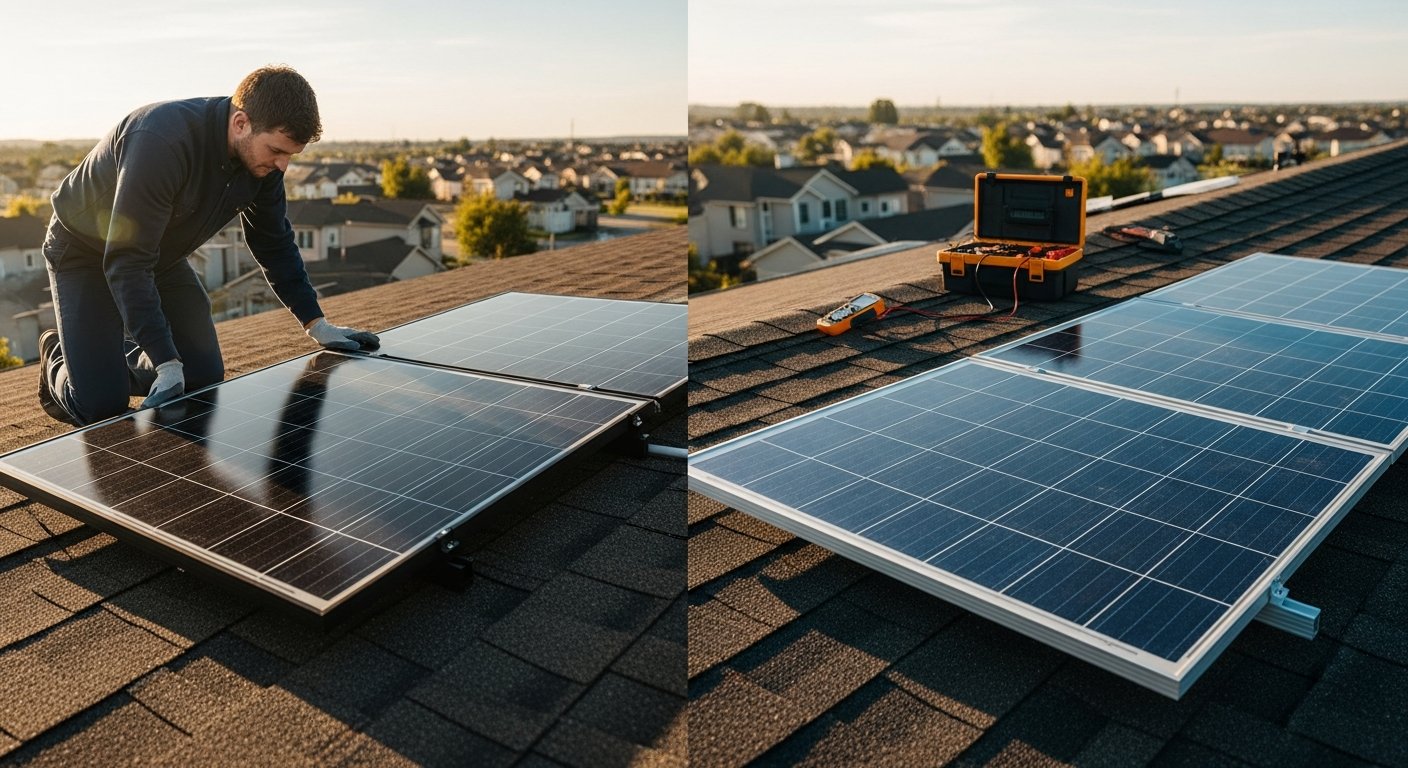
Premium Solar Panels: Worth the Higher Price?
Premium solar panels offer higher efficiency, longer warranties, and better durability. Learn if the extra cost is worth it for your home.
By Kassav Contributor
Learn more about Solar Panel Installation and Repair for guides, costs, and what to expect.
Compare Solar Panel Installation and Repair Pros Near You

Enter your ZIP code to compare top-rated local professionals and request free quotes.
When you start shopping for solar, the price gap between standard panels and premium solar panels can feel shocking. A top-tier module might cost 30 to 50 percent more than a budget option, yet both promise to generate electricity on your roof. So where does that extra money actually go? The answer determines whether you are paying for genuine long-term value or simply for a brand name. For most homeowners, the decision comes down to efficiency, durability, aesthetics, and the fine print of the warranty. This guide breaks down what truly separates premium solar panels from the rest, and how to decide if they are the right investment for your home.
What Defines a Premium Solar Panel?
A premium solar panel is not an official industry classification. Instead, it is a label that applies to products from manufacturers known for pushing the boundaries of efficiency, reliability, and design. Companies like SunPower, REC Group, Panasonic, and LG (before its exit) have built reputations for producing panels that outperform standard models in real-world conditions. These panels typically feature higher wattage ratings, lower degradation rates, and better temperature coefficients, which means they produce more power even on hot days.
The materials and manufacturing processes also differ. Premium panels often use N-type silicon cells, which are less prone to light-induced degradation than the P-type cells found in many budget panels. Some models use back-contact cells that eliminate front-side busbars, allowing more surface area to capture sunlight. Others incorporate advanced glass coatings and robust frames that withstand hail, wind, and snow loads better than conventional panels. These engineering choices translate into measurable performance advantages that can last for decades.
Key Performance Indicators
To understand what makes a panel premium, you need to look beyond the power rating. Four metrics matter most when comparing products:
- Efficiency: Premium panels typically exceed 22 percent efficiency, while standard panels sit around 18 to 20 percent. Higher efficiency means more electricity per square foot of roof.
- Degradation rate: Premium panels lose about 0.25 percent of output per year, compared to 0.5 to 0.7 percent for standard panels. After 25 years, a premium panel may still produce 92 percent of its original power.
- Temperature coefficient: A lower coefficient (around -0.29 percent per degree Celsius) means the panel loses less power as temperatures rise, which matters in hot climates like Texas and Florida.
- Warranty coverage: Premium panels often come with 25-year product and performance warranties, including labor coverage, while budget panels may only offer 10 to 15 years.
These numbers add up over time. A panel that degrades slower and tolerates heat better will generate more kilowatt-hours over its lifetime, which directly affects your return on investment. This is why many solar installers recommend premium solar panels for homeowners who plan to stay in their homes for more than a decade.
Efficiency: Why Premium Panels Produce More Power
Efficiency is the most obvious differentiator. A 400-watt premium panel with 22 percent efficiency will generate more electricity than a 400-watt standard panel with 19 percent efficiency when exposed to the same sunlight, because the premium panel actually captures more of the sun's energy. This gap becomes even more critical when you have limited roof space. If your roof can only fit 20 panels, choosing premium solar panels could mean the difference between offsetting 80 percent of your electricity usage versus 95 percent.
The technology behind this efficiency is worth understanding. Many premium panels use heterojunction (HJT) technology, which layers amorphous silicon on top of crystalline silicon cells. This structure captures a broader spectrum of light and reduces energy loss at the cell junctions. Other high-end models use half-cut cells and multi-busbar designs to shrink the distance electrons travel, which lowers resistance and boosts output. These innovations are not just marketing hype; they are measurable improvements that show up in third-party testing.
For homeowners with small or shaded roofs, the efficiency advantage can be the deciding factor. A system of premium solar panels may produce the same annual output as a larger system of standard panels, but with fewer modules. That means less visual impact, lower racking costs, and a simpler installation. In areas with strict setback requirements, like California's Title 24, premium panels can help you stay within the allowed footprint while still meeting your energy goals.
Durability and Warranty: Protection That Lasts Decades
Solar panels are a 25 to 30 year commitment, so durability is just as important as initial performance. Premium solar panels are engineered to withstand extreme conditions, from hurricane-force winds in Florida to heavy snow loads in Colorado. Their frames are reinforced, their glass is tempered to resist hail impact, and their encapsulation materials prevent moisture ingress that can cause micro-cracks over time. Some manufacturers even test their panels against simulated 50-year weather cycles before releasing them to market.
The warranty is where premium brands truly separate themselves. A standard panel might come with a 10-year product warranty and a 25-year performance warranty that guarantees 80 percent output. Premium solar panels often extend the product warranty to 25 years and guarantee 92 percent or higher output at the end of that term. Some premium manufacturers also include labor coverage, meaning if a panel fails, the cost of removing the old panel and installing the replacement is covered. This is a significant benefit, because labor can account for a large portion of a repair bill.
Beyond the warranty, premium panels are more likely to maintain their performance in real-world conditions. Standard panels can suffer from potential-induced degradation (PID), which reduces output when high voltage leaks through the module. Premium panels use advanced cell passivation and anti-PID materials to resist this failure mode. They also tend to have better bypass diodes, which keep the panel producing power even when part of it is shaded by a chimney or tree branch. These features add up to a system that delivers close to its rated output for its entire lifespan.
Aesthetics and Home Value: The Hidden Benefits of Premium Panels
Not all solar buyers are driven purely by math. For many homeowners, the look of the system matters. Premium solar panels are often designed with aesthetics in mind, featuring all-black backsheets, hidden busbars, and sleek frames that blend into the roofline. Some high-end models, like those with shingle-style solar, are nearly invisible from the street. This visual appeal can be a deciding factor for homeowners in neighborhoods with homeowners associations (HOAs) or for those who plan to sell their home in the near future.
Real estate studies consistently show that solar panels increase a home's resale value, and premium systems tend to add more value per watt than budget systems. Appraisers look at the quality of the installation, the age of the equipment, and the remaining warranty when valuing a solar system. A 5-year-old array of premium solar panels with a 20-year warranty looks much more attractive to a buyer than a 5-year-old budget system with a 5-year warranty. In competitive housing markets like California, Texas, and Florida, a premium solar installation can be the differentiator that helps a home sell faster and at a higher price.
There is also a psychological benefit. Knowing that your solar panels are built to last 40 years, with a warranty that protects you for 25, can give you peace of mind that a budget system cannot match. You are not just buying electricity; you are buying reliability and a reduced risk of future headaches. For homeowners who value simplicity and avoid surprises, this intangible benefit is worth real money.
Cost vs. Value: Is the Premium Worth It?
Let's talk about the elephant in the room: cost. Premium solar panels can cost $0.30 to $0.60 more per watt than standard panels. For a typical 6-kilowatt system, that is a difference of $1,800 to $3,600 before incentives. That is not pocket change, but it is also not the full picture. The true question is whether the extra upfront cost pays for itself through higher energy production and lower maintenance over the system's life.
Consider a concrete example. A homeowner in Houston installs a 6-kilowatt system of standard panels that produce 8,000 kilowatt-hours per year. At the local electricity rate of $0.12 per kilowatt-hour, that is $960 in annual savings. A premium system of the same size, with higher efficiency and lower degradation, might produce 8,500 kilowatt-hours in the first year, saving $1,020. Over 25 years, accounting for the slower degradation of premium panels, the premium system could generate an additional 12,000 kilowatt-hours, worth about $1,440 in extra savings. Add in the lower likelihood of needing a panel replacement or repair, and the gap narrows considerably.
When you factor in the 30 percent federal solar tax credit, the upfront cost difference shrinks further. A $3,000 premium costs $2,100 after the credit. If the premium panels last 40 years instead of 25, which many are rated to do, the per-year cost may actually be lower than a budget system that needs replacement sooner. For homeowners who plan to live in their home for decades, premium solar panels can be the more economical choice in the long run. For those who might move in five years, standard panels may make more sense, since you may not recoup the premium before selling.
When to Choose Premium vs. Standard
Here is a simple framework to help you decide:
- Choose premium solar panels if: You have limited roof space, live in a hot climate, want the best warranty, care about aesthetics, or plan to stay in your home for 10+ years.
- Choose standard panels if: You have ample roof space, live in a mild climate, plan to move soon, or are on a tight budget and want the lowest upfront cost.
This is not a one-size-fits-all decision. A good solar installer should offer you options at different price points and explain the trade-offs in terms of your specific situation. They should also show you how much each option will produce on your roof, using software that accounts for your local weather, shading, and roof orientation. With that data, you can make an informed choice that maximizes your financial return.
How to Buy Premium Solar Panels at the Best Price
If you have decided that premium solar panels are right for you, the next step is getting a fair price. The solar market is competitive, and installers often have different pricing for the same equipment. The best way to ensure you are paying a reasonable amount is to compare multiple quotes from certified installers. This is exactly what NewSolarQuotes does: it connects you with pre-screened, certified solar installers in your area, allowing you to receive up to three quotes without any obligation. By comparing quotes, you can see how different installers price the same premium panels and choose the one that offers the best combination of cost, warranty, and customer service.
When reviewing quotes, pay attention to the fine print. The price per watt is a good starting point, but it does not account for differences in mounting hardware, inverters, or workmanship warranties. Ask each installer to specify the exact panel model, inverter type, and the length of the labor warranty. A slightly higher quote may include a more robust racking system or a 25-year workmanship warranty, which is worth the extra cost. Also, confirm that the quote includes all necessary permits, interconnection fees, and any required electrical panel upgrades.
Financing is another area where premiums can vary. Some installers offer low-interest loans or lease options that let you go solar with zero upfront cost, but these products may include higher interest rates or equipment costs. If you can pay cash or use a home equity loan, you will typically get the best overall value. NewSolarQuotes also provides resources on solar financing, so you can understand the trade-offs between buying, leasing, and taking out a solar loan before you sign anything.
In the end, the choice between premium and standard solar panels is about balancing your budget with your long-term goals. If you value maximum efficiency, bulletproof durability, and a 25-year warranty, premium solar panels are a smart investment that will pay dividends for decades. If your priority is minimizing upfront costs, standard panels can still deliver solid savings with a shorter payback period. The key is to gather multiple quotes, understand the numbers, and choose a system that fits your home and your lifestyle. With the right partner, going solar can be one of the best financial and environmental decisions you ever make.
Learn more about Solar Panel Installation and Repair for guides, costs, and what to expect.
Compare Solar Panel Installation and Repair Pros Near You
Enter your ZIP code to compare top-rated local professionals and request free quotes.