
Smart Home Energy Management for Solar Owners
Discover how smart home energy management systems for solar owners can cut bills by 20-40% through automated load shifting and battery optimization.

By Andy Pearson
Learn more about Solar Panel Installation and Repair for guides, costs, and what to expect.
Compare Solar Panel Installation and Repair Pros Near You

Enter your ZIP code to compare top-rated local professionals and request free quotes.
You have made the switch to solar, and your panels are generating clean power on your roof. Yet, a nagging question remains: are you actually maximizing the value of every kilowatt-hour your system produces? Many solar owners discover that generating power is only half the equation. The other half is managing when and how you use that power, which is where smart home energy management systems for solar owners come into play. These systems act as the brain of your home's energy ecosystem, coordinating your solar production, battery storage, and household consumption to slash waste and lower your bills even further.
What Exactly Is a Smart Home Energy Management System?
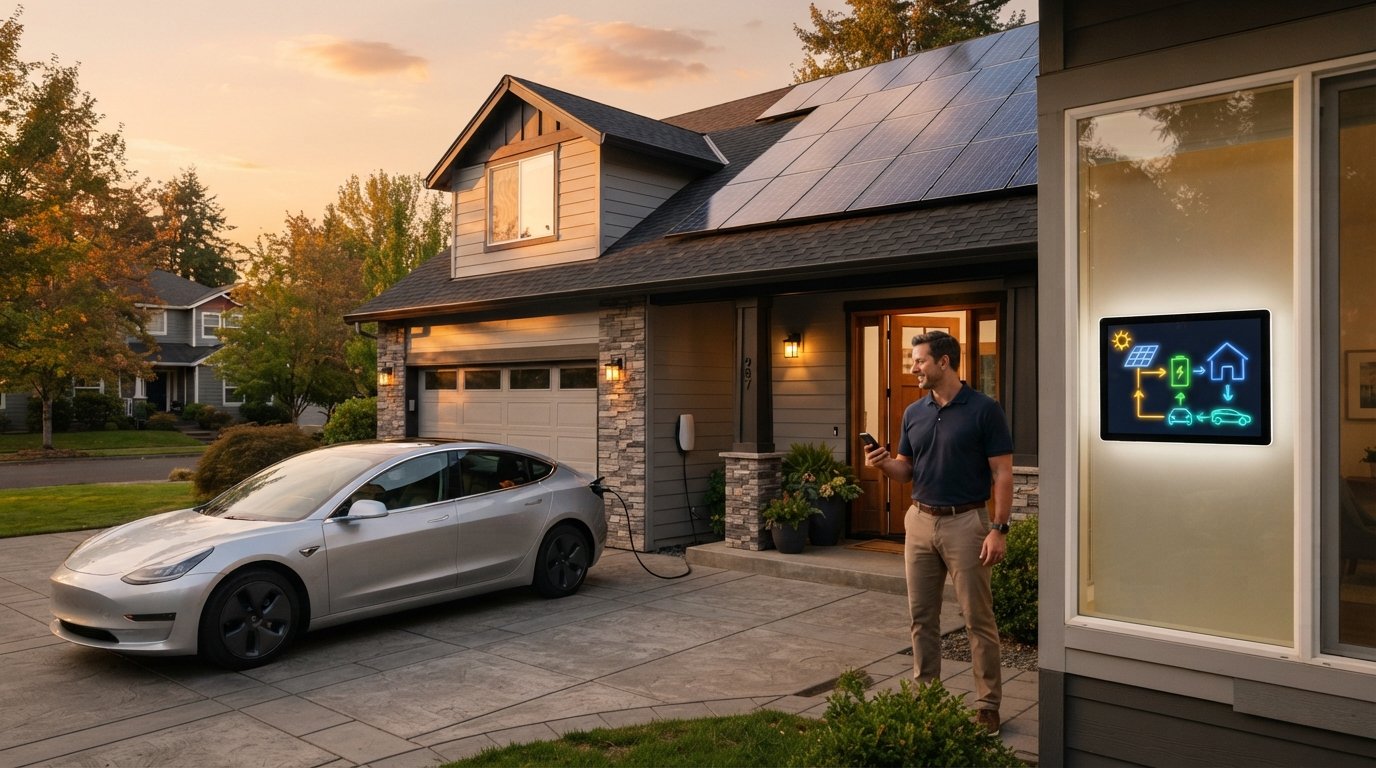
A smart home energy management system (HEMS) is a centralized platform, often a device or an app, that monitors, controls, and optimizes the flow of electricity in your home. For solar owners, it connects directly to your inverter, your smart meter, and increasingly, your battery storage. It tracks real-time solar production, household consumption, and grid import/export, then uses that data to automate decisions. For example, it might delay your electric vehicle (EV) charging until your panels are producing surplus power, or it might discharge your battery during peak evening hours when electricity rates are highest.
Unlike a simple monitoring app that just shows you how much energy you are generating, a HEMS actively manages your loads. It can communicate with smart appliances, thermostats, and EV chargers, creating a coordinated response to changing energy conditions. This distinction is crucial: monitoring tells you what happened, while a management system helps you change what happens next.
Why Solar Owners Need Energy Management in 2026
The energy landscape has shifted dramatically. Net metering policies, which once credited solar owners for every excess kilowatt-hour they sent to the grid, are being phased out or reduced in many states. Utility companies are moving toward time-of-use (TOU) rates, where electricity costs more during peak demand periods (typically late afternoon and evening) and less during off-peak hours. This change means that simply having solar panels is no longer enough to guarantee maximum savings.
Without a smart management system, you might be exporting valuable solar energy to the grid during the day for a low credit, only to buy it back at a high rate in the evening. This is known as the 'duck curve' problem. A HEMS solves this by shifting your energy consumption to align with your solar production. It ensures you use the power you generate, store it in a battery if you have one, and only pull from the grid when it is cheapest. For many homeowners, this can increase their solar savings by 20% to 40% annually.
Core Features of a High-Performing HEMS
When you start evaluating options, you will encounter a range of features. Not all systems are created equal, and the right one for you depends on your home setup and goals. Here are the core capabilities to look for in a modern smart home energy management system:
- Real-time monitoring and analytics: This provides a live view of your solar generation, home consumption, and grid interaction, often down to the circuit level.
- Smart load control: The ability to automatically turn on or off high-power appliances like EV chargers, water heaters, and pool pumps based on solar availability and electricity prices.
- Battery optimization: If you have a solar battery, the system intelligently manages charging and discharging cycles to maximize self-consumption and minimize grid dependence.
- Time-of-use rate integration: The system automatically shifts energy usage to off-peak hours to avoid high rates, even if you are not home to make manual changes.
- EV charging integration: It can schedule EV charging for when solar production is highest or grid electricity is cheapest, ensuring you drive on sunshine, not expensive grid power.
These features work together to create a seamless, automated experience. For instance, on a sunny Tuesday, your HEMS might decide to run your dishwasher at 1 PM, charge your EV to 80% by 3 PM, and store the remaining surplus in your battery. By 6 PM, when rates spike, your home is running entirely on stored solar energy, and you are barely drawing from the grid.
Choosing the Right System for Your Home
Selecting a HEMS is not a one-size-fits-all decision. The best system for you depends on your current equipment, your budget, and your future plans. If you already have a solar inverter from a major brand like Enphase or SolarEdge, their proprietary energy management platforms (like Enphase Envoy or SolarEdge Home Hub) are often the most seamless integration. They communicate directly with your inverter and provide advanced monitoring without additional hardware.
For those with a mix of equipment or a desire for a brand-agnostic solution, universal HEMS devices like the Sense Energy Monitor or the Span Smart Panel offer more flexibility. These clamp onto your main electrical panel and provide circuit-level insights, allowing you to manage any appliance regardless of the brand. However, they may require professional installation and may not control every device with the same precision as a proprietary system. When comparing, consider the following:
- Compatibility: Does it work with your existing solar inverter, battery, and smart appliances?
- Installation complexity: Can you install it yourself, or do you need an electrician? This affects upfront costs.
- Data privacy and security: How is your energy data stored and used? Choose a system from a reputable company with clear privacy policies.
- Scalability: Can the system grow with you if you add a battery, EV charger, or more smart appliances later?
Taking the time to answer these questions will prevent buyer's remorse and ensure you get a system that actually delivers on its promises. It is also wise to check if your utility offers rebates for installing a HEMS, as many are starting to incentivize this technology to better manage grid demand.
Real-World Savings and Payback Scenarios
It is natural to ask: is a smart home energy management system worth the investment? The answer is increasingly yes, especially for solar owners in states with TOU rates or reduced net metering. Let's look at a typical scenario. A home in California with an 8 kW solar system and a 10 kWh battery, facing TOU rates where peak electricity costs $0.50/kWh and off-peak costs $0.20/kWh, can save significantly.
Without a HEMS, the homeowner might export 15 kWh during the day, earning a credit of $0.05/kWh (a low export rate), and then import 15 kWh in the evening at $0.50/kWh. Their net cost for that energy is $6.75. With a HEMS, they can shift their usage, charge the battery during the day, and avoid importing during peak hours. Their net cost might drop to just the off-peak rate for any minimal grid draw, potentially saving $5 to $7 per day. Over a year, that translates to $1,800 to $2,500 in savings, which means a $1,500 HEMS pays for itself in less than a year.
Even without a battery, a HEMS can save money by shifting loads like EV charging and pool pumps to off-peak or solar-producing hours. The key is that the system provides the intelligence to make these shifts automatically, without you having to think about it every day. This is the difference between being an active solar manager and a passive solar owner. For a deeper look into how different solar panel technologies can affect your overall system efficiency, you might find our guide on polycrystalline solar panels helpful, as panel choice can impact how much surplus energy your HEMS has to work with.
Integrating Batteries, EVs, and Smart Appliances
The true power of a HEMS is unlocked when you have multiple energy assets to coordinate. A solar battery is the most obvious partner, as the HEMS controls its charge and discharge cycles based on your consumption patterns and rate schedule. But the integration goes further. Modern HEMS can communicate with your EV charger to pause charging during peak demand or resume it when solar production peaks. Some can even use your EV's battery as a backup power source during an outage, a feature called vehicle-to-home (V2H).
Smart appliances, such as Wi-Fi-enabled water heaters, dishwashers, and dryers, can also be managed. For example, a smart thermostat can pre-cool your home during the afternoon when solar power is plentiful, reducing air conditioning load during the expensive evening hours. The HEMS becomes the conductor of this orchestra, ensuring every device works in harmony. This level of automation not only reduces your bills but also increases your energy independence, making you less vulnerable to grid fluctuations and rising utility rates.
Future-Proofing Your Home Energy Strategy
As we look toward 2026 and beyond, the importance of home energy management will only grow. With the rise of electric vehicles, heat pumps, and home batteries, the average household's electricity demand is set to increase significantly. At the same time, utilities are increasingly relying on demand response programs, where they pay customers to reduce usage during critical times. A HEMS is your ticket to participating in these programs, earning extra credits or payments simply by letting your system automatically dial back non-essential loads when the grid is stressed.
Furthermore, as more homes adopt solar and storage, the grid is becoming more decentralized. Homes are no longer just consumers; they are 'prosumers' that can produce, store, and sell energy. A HEMS positions you at the forefront of this transition, giving you the tools to buy low, sell high, and optimize your energy portfolio. Whether you are looking to save money, reduce your carbon footprint, or achieve true energy independence, a smart home energy management system is the essential piece that ties it all together.
In conclusion, for solar owners in 2026, a smart home energy management system is not a luxury but a strategic necessity. It transforms your solar panels from a passive investment into an active, intelligent asset. By automating energy decisions, you maximize your savings, accelerate your payback period, and contribute to a more resilient energy grid. When you are ready to take this next step, consider exploring resources like SolarEnergy.ai for more data-driven insights into your solar production and consumption patterns. With the right system in place, you can ensure that every ray of sunlight that hits your roof is working as hard as possible for you.